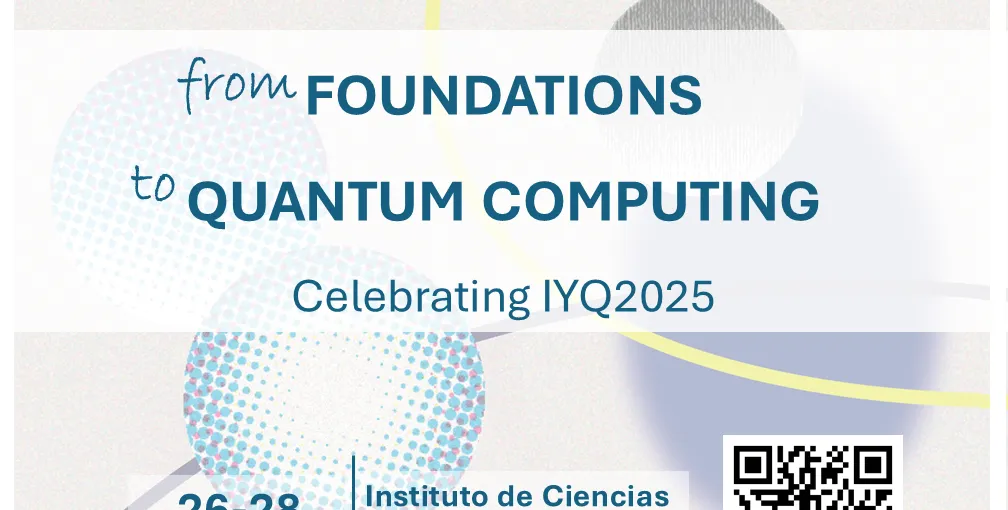
XIV Conference on Quantum Foundations at ICC UBA
The XIV Conference on Quantum Foundations (CQF 2025) was held at the Instituto de Ciencias de la Computación (ICC UBA) in Buenos Aires as part of the celebrations of the International Year of Quantum Science and Technology (IYQ 2025).
The meeting brought together researchers, postdoctoral fellows, and graduate students working on quantum foundations, quantum information, and quantum computation in a collaborative and highly stimulating environment.
Further information about the conference can be found at:
CQF 2025 featured a diverse program of invited talks spanning quantum foundations, quantum computation, quantum programming languages, quantum networking, and emerging quantum technologies.
Among the invited speakers, Pablo Arrighi discussed the structure of quantum cellular automata and their applications to the quantum simulation of quantum electrodynamics (QED). Alejandro Díaz-Caro presented recent advances on the logical and computational foundations of programming languages with quantum control.
David Elkouss explored optimization methods for NISQ-era quantum networks, while Laura Gatti examined alternative formulations of quantum computation based on discrete and integer structures. Matías Hampel presented ongoing developments at the Comisión Nacional de Energía Atómica (CNEA), covering technologies ranging from quantum detectors to quantum computing platforms.
The conference also included experimental and foundational perspectives. Alejandro Hnilo reviewed the historic Martelli experiments and their implications for the foundations of quantum physics, while Romina Yalovetzky presented qReduMIS, a quantum-informed reduction algorithm for the Maximum Independent Set problem, highlighting connections between quantum-inspired methods and combinatorial optimization.
Overall, CQF 2025 showcased the broad spectrum of contemporary quantum information science, connecting foundational questions with practical implementations, computational complexity, and emerging quantum technologies.
The conference also provided an excellent opportunity for students and young researchers to present their work and interact closely with leading scientists in the field.
CQF meetings continue to strengthen the local and regional quantum information community while fostering international collaborations across foundations, computation, and quantum technologies.